Regional pricing

Fair for everyone

Based on the World Bank’s purchasing power parity data, Fontwerk developed a concept for regional pricing.

Our typefaces support all Latin languages in Europe, some families additionally support African, Arabic, Hebrew, and Cyrillic languages as well as Greek and Thai. In 2026, we will release our first Indian fonts. Fear not, the price will not increase due to the language extensions, you will always receive the maximum character set.

W

e pride ourselves in expanding our library to include high-quality fonts that speak many languages, and are committed to reaching regions that have not previously had access to a comparable selection of professional fonts.

If we take this approach seriously, there is still a problem: for many international customers, our European-based pricing remains unaffordable. Even €70 for a single style can exceed the whole budget in some parts of the world. With the relaunch of the website last year, we aimed to offer a fairer model.

Based on the World Bank’s purchasing power parity data, which shows differences in the cost of living and the relationship between exchange rates and price levels between different countries, we developed a concept for regional pricing. We initially tested it for African countries during summer and then later expanded it to Asia.

A year since the relaunch of our website, we are now rolling out the program worldwide.
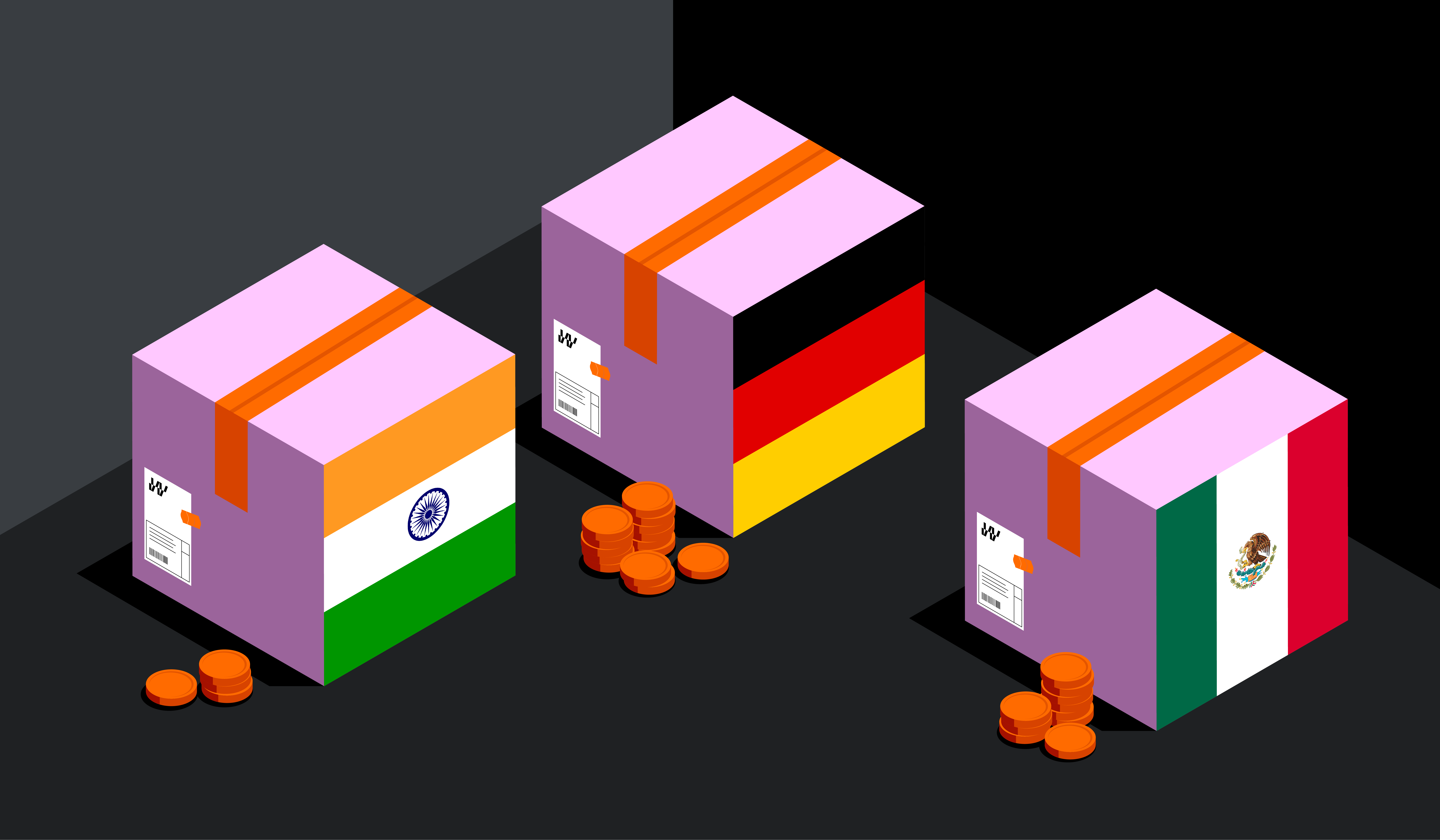
Based on the World Bank’s purchasing power parity data, Fontwerk developed a concept for regional pricing.
Same products, locally different prices
How does regional pricing work?

Since we are based in Germany, our pricing is based on our local cost structures. We use our own prices as a benchmark, so they correspond to 100%. The World Bank bases its pricing on the United States.

What does this mean for our approach? For example: An item costs $1.00 in the US. The same item costs $0.77 in Germany and $0.24 in India. We multiply 0.77 by factor X (0.77 × X = 1). This factor X is the quotient of 1/0.77 ≈ 1.3. The values for the individual countries are multiplied by this factor of 1.3, for India accordingly 0.24 × 1.3 ≈ 0.31. Indian customers therefore see and buy at prices multiplied by this factor. In this example, a single weight is reduced to €22 instead of €70 (rounded to full amounts). The World Bank’s purchasing power parity data currently has the greatest effect on Nigeria (85%), Egypt (77%), and Burundi (76%).

We do not take into account countries where the effect would be less than ten percent. For legal reasons, the states of the European Union are also omitted. Since we do not want to increase our prices for anyone, countries that are ranked above Germany in the current ranking are also excluded from the geographical price adjustment (e.g. Australia, Canada, Israel, United Kingdom, and the USA).

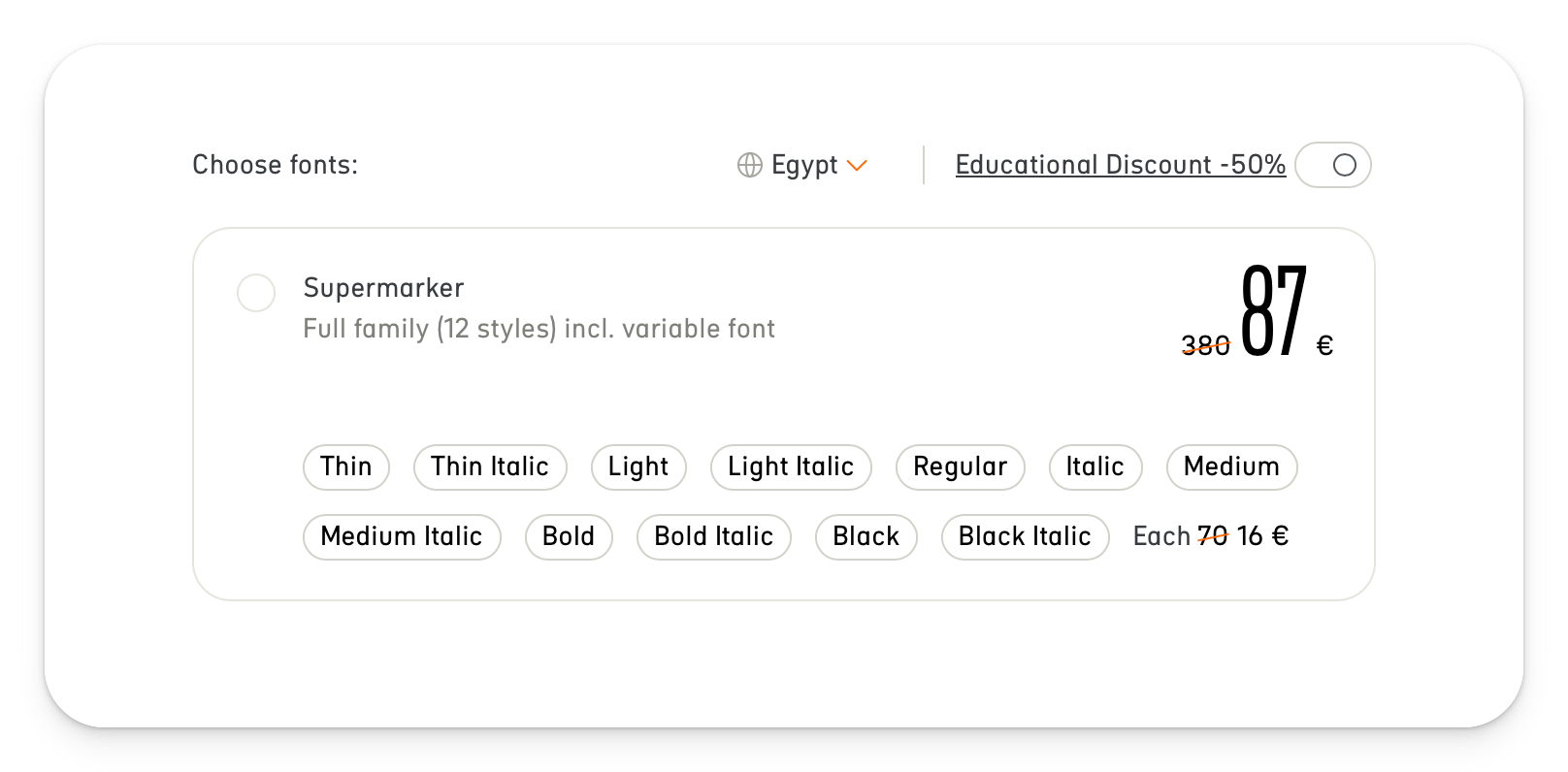
Nothing will change at checkout for those countries, all others will see their preselected country as a drop-down menu via geotargeting. Since the index can change significantly over time, we will update the factors at least annually.

Based on the World Bank’s purchasing power parity data, Fontwerk developed a concept for regional pricing: Screenshot Checkout fontwerk.com
The preselected country will be presented as a drop-down menu.

We hope that this model will enable us to better reflect the realities of life for all of our customers. If you live in one of the countries benefiting from this initiative, please let us know whether we have succeeded in doing so or what measures might be more appropriate.

We would also like to thank our fabulous designers, who supported this project from the start.